Today's topic: STARFISH Defense!!
 Its curious how often this question comes up. People see starfish and other echinoderms that are just sitting there. Echinoderms don't work in our time scale-and to our perception, they just kind of sit there.
Even other echinoderms seem to have the defense thing worked out!
Sea urchins got spines. Like these.
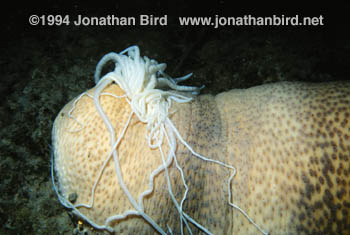
Sea cucumbers got that evisceration/gut spewing thing (uh...I'll describe this later but its just gross!).
Crinoids can get all swimmy and do all sorts of things to escape. Click here to see some.
Ophiuroids got arms they can drop.
But starfish? How are these seemingly innocuous creatures able to protect themselves?
 How do they get away? When things come after them? What comes after them?
Today...a survey of what sea stars use to defend themselves against their various predators and adversaries.
What are starfish usually worried about? Usually fish...but also crabs, and sometimes other echinoderms...
1. Chemical Defenses. So, this is the one most people seem to miss, but its probably one of the most important. Most starfish have specific type of organic chemical called SAPONINS in their body wall.
 Among animals (saponins are also found in plants), saponins are only present in sea cucumbers and starfish. Saponins are very unpleasant tasting and based on studies, such as this one and this one, are found in the larvae as well as the adults.
So, fishes and other predators basically learn that starfish are just AWFUL. In vertebrates, such as cats and/or dogs eating starfish and being poisoned by sapoinins can cause vomiting, nausea, and other unpleasant effects. Humans should take this hint and go with it...
Some species, such as this Astropecten polyacanthus have kicked their defenses up a notch and instead of (or possibly in addition to?) saponins, their body walls contain the deadly TETRODOTOXIN.
 (photograph by Cory Pittman)
 Tetrodotoxin gets its name because it is naturally occuring in puffer fish (order Tetrodontiformes). Wikipedia has an interesting article on it here.
Chemical defense also include the production of SERIOUS amounts of toxic materials such as MUCUS (grammar factoid! Mucus=noun. Mucous=adjective!) in the "slime star" Pteraster tessellatus (and probably all of its relatives in the Pterasteridae.)
 This picture is no exaggeration. I've seen these animals produce BUCKETS of mucus in response to being annoyed. Early studies of Pteraster in the lab showed that other animals clogged by the mucus eventually die, suggesting that its not a substance that likely predators are fond of....
2. Armor & Spines. One of the more obvious features one sees in starfish, especially in tropical species is the presence of heavily developed armor and armament, such as the spines in this Protoreaster nodosus.
 To be honest, armor and spines as defensive are usually interpretations of how the body forms function in the wild. Tropical starfish in the family Oreasteridae, such as Pentaster and Pentaceraster (below) almost all have these heavily developed bodies.
 One major group of starfishes, the Valvataceans, which includes the Oreasteridae and other starfish groups with heavily calcified bodies, are highly diverse and considered evolutionarily successful in tropical regions, especially in the tropical Indo-Pacific.
Its thought that these armored bodies are part of why these starfish are so successful.
For example, here's the underside of the starfish Tosia. The tube foot groove is flanked by thick blunt spines.
 These spines close up over the tube foot groove and clasp together. This is thought to protect the animal's tube feet and soft tissue from small predators, such as little shrimps, worms and fish.
In the New Zealand Pentagonaster, there are big, thick armor plates that cover over the armtips.
These are thought to similarly protect the armtips from fish, crabs, and/or other predators that attack the armtips.If predation pressure is that much higher in the tropics-that may drive the evolution and diversification of tropical starfish species..
The crown of thorns starfish, Acanthaster planci is a big ol' starfish bad-ass. Its got the morphological defenses...the sharp spines AND it has saponins in its body wall.
 Even if you look at something familiar like the intertidal Pisaster live in harsh wave-swept regions and have heavily calcified armor that I would say protects them the elements and other predators.
3. Regeneration. Finally...most people are pretty aware of how starfish regenerate...
There's a LOT more I can write about regeneration but the video covers the basics...
One interesting point, however, is also brought up by this paper by Marrs et al. 2000 on arm damage in the North Atlantic Asterias rubens.
They hypothesize that larger individuals have "increased mechancial toughness" and that this replaces the shedding of arms (i.e., autotomy) as an antipredator strategy. There may be a size-related decline in the efficiency of the autotomy mechanism through the relaxation of selection pressure (i.e., the influence of predators).
 This was an idea applied to individuals within this species..but if true, then large size itself could be another defense!! One possible explanation for why oreasterids are so big?? Or possibly other species?