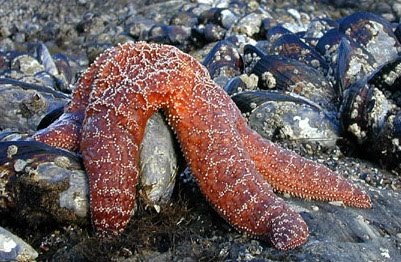
Its been awhile since I've had a chance to share some cool starfish videos and there's some awesome new sunflower star video on YouTube!
1. The "mound" of moving Pycnopodia helianthoides ! A video from the Vancouver Aquarium. Research diver Donna Gibbs was out and observed this spectacular spectacle. I dont' think I've ever seen a huge aggregate of sunflower stars like this before! Literally climbing over each other in high densities. The Vancouver Aquarium folks speculate on temperature or red tides as the cause..I wonder if it might be some kind of odd reproductive behavior. Anyway...its weird and spectacular!
2. Sunflower stars battlin it out! Nuff said!
3. Sunflower star TIME LAPSE turn over. If you don't love watching starfish time lapse-then you have become TIRED OF LIFE!!!
4. Sunflower Stars VERSUS the SCALLOPS!! Watch the Godzilla of starfish terrorize a bunch of hapless bivalves! ha! Silly Scallops!! Watch them RUN!
5. Finally... there's always THIS favorite... Sunflower star clears out the hapless brittle stars and sand dollars around it! THAT is who's boss! All to a hip soundtrack of Vivaldi's Four Seasons!
Monday, April 5, 2010
Tuesday, March 30, 2010
Why is Pisaster ochraceus (aka ochre star) so many colors? AKA they are what they eat!
So, early in my career during my various internships and volunteer time, I spent a fair bit of time at the educational tidepools exhibits at the California Academy of Sciences and Monterey Bay Aquarium.
One of the most common questions I would get about the commonly encountered "Ochre Stars" (Pisaster ochraceus) that live on the west coast of North America.
"Is there any significance to the color?" (or some variant thereof)
Well, its taken nearly 15 years but FINALLY...I can answer this question! I thank a neat paper by Harley et al. 2006 in the Biological Bulletin, which is available via Open Access!
So, here's the story!
This species lives along the coast from Alaska to California, including British Columbia, Washington, and Oregon.
These animals have a brilliant and very distinctive suite of colors that stand out. These include
PURPLE...
BROWN (or RED)

and... ORANGE
...and in fact, the species epithet, "ochraceus" in "Pisaster ochraceus" or the common name "Ochre Star" refers to the yellow-brown color, which was probably the living color of the the first specimens that were described of this species.
It turns out that the colors DO indeed VARY with region. Different places along the west coast have variable colors. Of populations they surveyed from 31 sites in California (North & South), Oregon, Washington, British Columbia, and Alaska. (diagram below is NOT proportional)
Across the surveyed sites, they found that on the whole MOST of them were brown-reddish with a relative minority of orange colored members as part of the population.
Curiously, those in certain isolated channels..in Georgia Strait (British Columbia) and Puget Sound (Washington) were 95% PURPLE!!
In addition to color, they further examined other factors: food, size, and injury. And ran them together with a cluster analysis.
And they got a diagram that showed overall similarity between members from each of the different sampled study sites.
There was a close association between all of the populations in California, Washington, and Oregon (seems like Alaska was omitted).
The Georgia Strait and Puget Sound populations (the purple ones) clusters together AGAIN.
COULD these purple populations be something new or different???
A logical question to ask at this point. Did this separate purple population or ANY population of this species have enough separation or structure to warrant consideration of a new species??
So, The study looked at population genetics of P. ochraceus.
That is, the amount of genetic structure was present in the various populations within the species across its distributed range.
Essentially, there was NO structure of populations across the range.
That is to say, that an individual from San Diego (southern range) and an individual from Alaska (northern range) were really NOT all that different. Gene flow between populations remained high (that is, no subset of the gene pool had been significantly isolated)
They found NO "obvious" relationship between color and each population.
So, to put it in much simpler terms- There is no color (or other) subset of this species that has become isolated enough that its about to become a separate species or even a genetically separated population.
WHAT's going ON with the PURPLE ones then????
One of the coolest conclusions of this paper was that COLOR in P. ochraceus is probably related to what individuals of this species ATE.
So, it turns out that individuals from California, Oregon, and Washington?
They enjoy eating The mussel Mytilus californianus
...and now we get to the PURPLE ones from the isolated inlets in Georgia Strait and Puget Sound. What's different about these isolated areas that's different from the open ocean populations?
THEY AIN'T GOT NO MUSSELS!!!
Instead, they have ACORN BARNACLES!! (Balanus spp.)
The immediate correlation seemed to be that this ecological/external effect (i.e., food type) was the reason why you get purple Pisaster ochraceus. It turns out that the mussel Mytilus contians carotenoid pigments, which are the same KIND of pigment that are responsible for the orange color in carrots!!
Harley et al. hypothesize that the mussels provide the pigment that yields the light orange/red color
and that those ochre stars deprived of mussels REVERT back to the bright PURPLE color!!! (note that mussels are absent in the pic below!)
They point out that the color still varies among individuals-some orange, some red/brown, and some in between. So, there might yet be an underlying genetic component to the variation in color.
They add anecdotal accounts that some orange adults turn purple when held for long periods under laboratory conditions and that small individuals of Pisaster are actually not fixed on a color. So SIZE and maturity may also be important factors.
But the authors save the best for last. They also speculate that those factors that affect color are apparently stable over relatively long ecological time scales.
In some places, such as the famous Pacific Grove, California (home to Ed "Doc" Ricketts and Cannery Row), they were able to determine that Pisaster size, color frequency and diet have not significantly changed in over HALF a Century!!!
So, this famous population of sea stars has not undergone any real changes in prey abundance for the last 60 years or so!
One of the most common questions I would get about the commonly encountered "Ochre Stars" (Pisaster ochraceus) that live on the west coast of North America.
"Is there any significance to the color?" (or some variant thereof)
Well, its taken nearly 15 years but FINALLY...I can answer this question! I thank a neat paper by Harley et al. 2006 in the Biological Bulletin, which is available via Open Access!
So, here's the story!
This species lives along the coast from Alaska to California, including British Columbia, Washington, and Oregon.
These animals have a brilliant and very distinctive suite of colors that stand out. These include
PURPLE...
BROWN (or RED)

and... ORANGE
...and in fact, the species epithet, "ochraceus" in "Pisaster ochraceus" or the common name "Ochre Star" refers to the yellow-brown color, which was probably the living color of the the first specimens that were described of this species.It turns out that the colors DO indeed VARY with region. Different places along the west coast have variable colors. Of populations they surveyed from 31 sites in California (North & South), Oregon, Washington, British Columbia, and Alaska. (diagram below is NOT proportional)
Across the surveyed sites, they found that on the whole MOST of them were brown-reddish with a relative minority of orange colored members as part of the population.Curiously, those in certain isolated channels..in Georgia Strait (British Columbia) and Puget Sound (Washington) were 95% PURPLE!!
In addition to color, they further examined other factors: food, size, and injury. And ran them together with a cluster analysis.
And they got a diagram that showed overall similarity between members from each of the different sampled study sites.
There was a close association between all of the populations in California, Washington, and Oregon (seems like Alaska was omitted).
The Georgia Strait and Puget Sound populations (the purple ones) clusters together AGAIN.
COULD these purple populations be something new or different???
A logical question to ask at this point. Did this separate purple population or ANY population of this species have enough separation or structure to warrant consideration of a new species??
So, The study looked at population genetics of P. ochraceus.
That is, the amount of genetic structure was present in the various populations within the species across its distributed range.
Essentially, there was NO structure of populations across the range.
That is to say, that an individual from San Diego (southern range) and an individual from Alaska (northern range) were really NOT all that different. Gene flow between populations remained high (that is, no subset of the gene pool had been significantly isolated)
They found NO "obvious" relationship between color and each population.
So, to put it in much simpler terms- There is no color (or other) subset of this species that has become isolated enough that its about to become a separate species or even a genetically separated population.
WHAT's going ON with the PURPLE ones then????
One of the coolest conclusions of this paper was that COLOR in P. ochraceus is probably related to what individuals of this species ATE.So, it turns out that individuals from California, Oregon, and Washington?
They enjoy eating The mussel Mytilus californianus
...and now we get to the PURPLE ones from the isolated inlets in Georgia Strait and Puget Sound. What's different about these isolated areas that's different from the open ocean populations?
THEY AIN'T GOT NO MUSSELS!!!
Instead, they have ACORN BARNACLES!! (Balanus spp.)
The immediate correlation seemed to be that this ecological/external effect (i.e., food type) was the reason why you get purple Pisaster ochraceus. It turns out that the mussel Mytilus contians carotenoid pigments, which are the same KIND of pigment that are responsible for the orange color in carrots!!
and that those ochre stars deprived of mussels REVERT back to the bright PURPLE color!!! (note that mussels are absent in the pic below!)
They point out that the color still varies among individuals-some orange, some red/brown, and some in between. So, there might yet be an underlying genetic component to the variation in color.They add anecdotal accounts that some orange adults turn purple when held for long periods under laboratory conditions and that small individuals of Pisaster are actually not fixed on a color. So SIZE and maturity may also be important factors.
But the authors save the best for last. They also speculate that those factors that affect color are apparently stable over relatively long ecological time scales.
In some places, such as the famous Pacific Grove, California (home to Ed "Doc" Ricketts and Cannery Row), they were able to determine that Pisaster size, color frequency and diet have not significantly changed in over HALF a Century!!! So, this famous population of sea stars has not undergone any real changes in prey abundance for the last 60 years or so!
Monday, March 22, 2010
When Sea Urchins ATTACK!!! Crinoid EVASION=Crinoid EVOLUTION!!
Ya' know what I love about today's post? When ya' got two great things that go great together!!!
This article is based on this brand spanking NEW paper by Tomasz Baumiller along with his colleagues in the new Proceedings of the National Academy of Science. Go here for the citation.
and has already gotten some play in Astrobiology Magazine....
You may recall, early in the Echinoblog, I wrote about the predation on stalked crinoids (above) by cidaroid sea urchins. (Click to see!)To recap, both cidaroids and stalked crinoids are "living fossils", a term used to describe living animals that closely resemble (or are related to) critters that we are accustomed to seeing only as FOSSILS.
This makes them good analogs for inferring past ecological interpretations.
A few years ago Tomasz Baumiller and his colleagues, found that these sea urchins actually ATE stalked crinoids!!
This was surprising! Urchins as carnivores???? We generally think of sea urchins as algae-grazing, poop-producing, spiny balls. Sort of like the cows of the sea.
So, they pursued the matter!! Seeking out evidence from all corners of the EARTH that these Urchins were not cows, but the marine equivalent of ravenous, bloodthirsty BEASTS! And that evidence was FOUND!
1. Living Evidence. The authors looked at the shallow-water tropical urchin Eucidaris which was examined live in aquaria alongside the shallo-water crinoid Lamprometra palmata (along with some deep-sea crinoid bits as a further test of whether they would be appealing!)
Do the urchins go for it??
(image courtesy of T. Baumiller)They DO indeed go for it!! Now, Eucidaris doesn't exclusively go after crinoids-but it DOES indeed like eating them up!!!
The picture above shows part of a crinoid (the small white bit) being devoured by the cidaroid urchin Eucidaris.
You can click here to see the movie at the PNAS website of this beast feeding!
Here's some pix!! Here's what's called a brachial-essentially one of the arms off the "chewed on" crinoid. (see here to see where a brachial goes)
(image courtesy of T. Baumiller)..and a close up of the cidaroid POOP! An arm segment that's been digested and passed!
(image courtesy of T. Baumiller)
2. FOSSIL Evidence!!See the notches on that bottom segment?? Those are made by the JAWS on the urchin!
They leave a mark. This is important....
The authors wanted to see how far into the history of these animals this relationship may have lasted.
How could they tell? They looked for the NOTCH (from above).
They looked through 2,500 fragments of fossil crinoid stalks from five Triassic (Mesozoic) sites in Poland. More then 500 of these pieces (about 20% of the total) had these scratches and notches!!
Its entirely possible these marks could be explained through other reasons. Scavengers or perhaps environmental factors that erode or deform the remains?
But they argue that these fossil deposits were buried quickly-suggesting that the marks were made when they were alive as opposed to scavengers.
They also found that cidaroid spines and test fragments were present around damaged crinoid body parts at these Triassic fossil sites.
So, Yeah. They ATE them.
3. So, WHY IS THIS IMPORTANT???
So both crinoids and sea urchins (as well as most other marine animals) undergo a massive extinction event at the end of the Paleozoic.
The great end-Permian event (click here to get more info) resulted in near-extinction of most Paleozoic crinoids and sea urchins.
But this was followed by a BIG rebound. In otherwords, they survived and RE-DIVERSIFIED.
Many of the older taxa went away-and this was followed by new body forms, which exploited those which had gone extinct. This "re-set" of animal diversity is called the Mesozoic Marine Revolution.
So what happens to the cidaroid urchins? They started getting STRONGER and more effective jaws.
And Crinoids?? CRINOIDS BECOME MORE MOBILE!!!Some got into FLOATING....(see here for more on this-not everyone agrees on interpretation of these)
Some lost the stalk and learned how to SWIM....
Based on this, the authors suggest that there was a sort of "escalation of arms". Armament went "up" in the predator and so Defense correspondingly rises in they prey. A sort of Mesozoic Arms Race is at play.... One driving the other.
Thus, the GREATER mobility seen in crinoids was A REACTION TO THEIR PREDATORS...Namely...cidaroid sea urchins!!!
You get a bigger jaw? We're gonna swim away! Get armor! Whatever it takes.
Thus, this relatively straightforward predator/prey relationship has conceivably driven the evolution of this group for hundreds of millions of years.
Wow. Tasty.
Labels:
cidaroid,
Crinoidea,
escalation,
mesozoic marine revolution,
predation
Subscribe to:
Posts (Atom)


_01.jpg)