 So, today you guys get something a little special that I've been cooking up! After a few years of gathering specimens and working up data, I finally published this paper with Martha Nizinski of the National Marine Fisheries Service (NMFS) and Lonny Lundsten of the Monterey Bay Aquarium Research Institute (MBARI).
Basically, my paper describes THREE new species and one new genus in the subfamily Hippasterinae, which is a group within the family Goniasteridae. Goniasterids occur all over the world and and are probably the MOST diverse of all the starfish groups with some 64 genera and close to 260 species!
This one subfamily, the Hippasterinae, includes the familar Hippasteria (below) which live primarily in the deep-sea, but in some parts of the world, can be seen SCUBA diving depending on where you live (e.g., Washington, Oregon, British Columbia, etc.).
 Hippasteria has been known to humanity for a LONG time. It was literally one of the first sea stars described by European scientists in 1840. But for the most part, its a deep-sea species and we didn't know much about it or its relatives up until recently.
So, it turns out that Hippasteria's got some pretty important eating habits. It and its relatives are voracious predators of cnidarians, specifically deep-sea CORAL. I've written about various sea star corallivores before (early on in the Echinoblog-here).
But as a quick reminder-Hippasteria (and its relatives) aren't the ONLY asteroids that feed on "corals" (which can be broadly defined as almost any cnidarian with a biogenic skeleton).
 Shown above, is Acanthaster planci-the infamous Crown-of-Thorns starfish which attacks and devours primarily shallow-water tropical "hard" coral (i.e., scleractinian). While the above species has grown to plague proportions-it is an important member of the coral-reef ecosystem. As it is likely these deep-sea corallivores are ALSO likely to be... So, how did this whole process begin? As with many things...it started with me identifying a starfish...
 Discovering New Deep-Sea Coral Eating Starfish!
 My colleague, Dr. Martha Nizinski approached me several years ago with some pretty large-sized starfishes from the tropical Atlantic.
These were in the NMNH collections as part of the considerable "backlog" of unidentified material from her studies with the Johnson Sea Link. I had just arrived and was examining everything that I could...
 It turns out that there were not one but TWO species among the specimens that Dr. Nizinski had collected!
One was a rare species called "Hippasteria" caribaea that turned out to be incorrectly classified and was more properly placed in a Pacific-only genus called Gilbertaster, making the full correct name Gilbertaster caribaea.
It turns out that Gilbertaster caribaea is rarely encountered. Only 6 specimens are known
 Its a very neat looking animal with all of these very LARGE lip-shaped pedicellariae.
 Pedicellariae are pincer or wrench-shaped structures that sea stars use to interact with the environment.
Perhaps they are used to fend off predators? or perhaps to keep their surfaces clear of settling debris? Its not clear what the function is in all taxa... but one thing IS clear? There's a LOT of pedicellariae on the body surface...(each lip-shaped pedicellariae is about 2-5 mm long each)
 and there's a bunch of them on the oral surface around the mouth (again, each about 2-5 mm long each)
AND in addition to Gilbertaster caribaea above, there was ANOTHER SPECIES. One that had NOT been recognized by scientists before. Not only was it a new species...but a new GENUS.
The animal has a really stout, heavy body and so I called it Sthenaster from the Greek "sthenos" for strength and -aster for star. So, "Strong Star"
 It too has the many, many large pedicellariae...
 Finally, I named the species after my colleague Dr. Emma Bullock in the NMNH Mineral Science Department, with the name Sthenaster emmae !!
Dr. Bullock is shown here holding her namesake!
 At about the same time, Lonny Lundsten, one of my colleagues from the West coast at the Monterey Bay Aquarium Research Institute had just returned from several cruises off the coast of California..
 And he had discovered several NEW specimens of ANOTHER rarely encountered sea star in the genus Evoplosoma. At the time, Evoplosoma was known less than about a dozen specimens worldwide
Here's a pic of the Atlantic species to give you an idea of what they look like...

 Lots of spines and pedicellariae...
Well, it turns out that Lonny had MORE than just the preserved specimens..he also had VIDEO and photos of these animals on the sea bottom (>2000 m depths!) doing stuff like this!
 NO species of Evoplosoma was known from off the west coast of North America! After examining specimens, it turned out there were TWO distinct species of Evoplosoma present. Both were observed feeding on deep-sea corals.
 I named one, Evoplosoma voratus. "Voratus" means to "greedily devour" and the second, Evoplosoma claguei I named for Dr. David Clague an MBARI Geologist who headed the mission and collected several of the specimens!
 I proceeded to engage in a phylogenetic analysis of these and other related sea stars in the Hippasterinae/Goniasteridae, including Hippasteriaand the closely related Cryptopeltaster
 using computer software to analyze the external characters to group similar taxa together...
 To get a tree that looks like this!
  The tree shows some interesting stuff... the genus Evoplsoma is found ONLY in the deep-sea and is probably a derived (i.e., highly specialized) member of the Hippasterinae. And so, its ancestors probably hail from a shallow-water ancestor.
I also realized that there were observations of coral predation from nearly EVERY member of the Hippasterinae. There was no evidence for Gilbertaster feeding on coral-but there was for all the rest.
As you can see here, the starfish is actually climbing UP the stalk and leaving the skeleton of the animal devoid of living flesh as it devours the animal like delicious deep-sea cnidarian lollipop!
 I checked the gut contents of our new genus and species, Sthenaster emmae which had been collected in close proximity to deep-sea corals! Examining the food left in the stomach of these animals resulted in our discovering ...SCLERITES
 Sclerites are skeletal bits from certain kinds of deep-sea corals. They are also distinctive enough for some species that they can be used to identify species!! Later examination of the collection video of these animals did in fact show that these WERE feeding on deep-sea corals!
I've also gotten to looking for these animals on the internet. Its actually seen on quite a few oceanographic expeditions in the Atlantic and the Pacific!
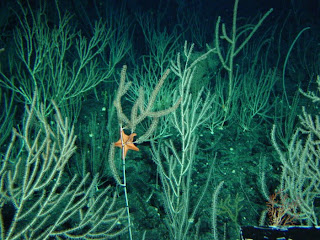
Here is an image from a 2004 Alaskan Seamount expedition. Probably Hippasteria...
 Here's another image of what is probably Evoplosoma from the same 2004 Expedition
 And from a 2003 HURL mission to Hawaii...Although I'm not sure which species this is..
 and I observed Evoplosoma on the 2009 Pacific Northwest Expedition!
And this 2004 account of what turns out to be a new species of Evoplosoma from Bear Seamount in the Atlantic!
 Potentially, we are seeing the discovery of a pretty widespread ecological interaction...and an important part of understanding deep-sea corals! A conservation priority in the deep-sea as outlined by NOAA and others...
Hopefully the paper will find good use as discovery of these sea stars becomes increasingly more common...

.jpg)


