Showing posts with label deep-sea. Show all posts

Tuesday, August 10, 2010

Hawaiian Deep Sea-Urchins!!! Below the Surface of a Tropical Paradise!


So, following up on the Hawaiian deep-sea starfish post from a few weeks ago...I thought it would be cool to show some other echinoderm diversity...and who doesn't love sea urchins???
A brief background on where these pictures came from... These were ALL taken by the Hawai'i Undersea Research Laboratory (HURL) at the University of Hawai'i at Manoa and are all species that live in deep-water in and around the Hawaiian Islands. HURL operates two manned submersibles..the Pisces V and the Pisces VI.
I went down and deep-sea stalked my echinoderm loves in the Pisces V back in 2000. The following are not images from that expedition but a mix of pix from past voyages of HURL's Pisces V submersible... Thanks to Chris Kelley at HURL for allowing me to use them!

1. Aspidodiadema hawaiiensis.
Here's a neat species that is also observed in the Bahamas. It has these long freaky spines, which they use to MOVE.

These urchins remind me of the giant black spy spider robot from Johnny Quest....


2. Phoromosoma bursarium. What survey of deep-sea echinoderms is complete without some echinothuriids?? I wrote up a blog on these for Deep-Sea News awhile back as one of the 27 BEST Deep-Sea species (it made the top 10!).

Basically, these are weird urchins that walk around on hoof-like spines. Some genera have these big puffy sacs of unknown function.
But one thing I HAVE experienced from firsthand observation-those spines on these critters? They STING. A colleague of mine at MBARI experienced this during the North Pacific Expedition last year.

3. Chaetodiadema pallidum. There's not very much known about this species, but in and around the Hawaiian region between 50 and 402 m on fine sediment.
These can be VERY abundant... and bringing up a bunch of them doesn't do them justice when they are observed on video arranged in these almost unnatural distribution patterns... spooky!
Who needs science fiction when you've got reality?

4. Chondrocidaris gigantea..Speaking of freaky... Here's one of the shallower-water urchins that you see in deeper waters.. Note that the spines are completely covered over by overgrowth..sponges or other encrusting invertebrates, perhaps?

In this species and other cidaroid urchins (you'll be seeing these below) the spines LACK epidermis and you get all kinds of weird things growing on them..

Here's a little bit I wrote up on them last year...(a bit dated by the holiday theme)
5. Prionocidaris hawaiiensis. Another urchin about which we know very little...
Except that we know where they occur in 92-214 meters? They are VERY abundant!
6. Histocidaris variabilis. What's weird with this one? It has BARNACLES that grow on the spines!! Similar in some ways to the way that Chondrocidaris has sponges and etc. on the spines...
7. Acanthocidaris hastigera. Not much known about this one..but dang, its cool-looking ain't it?
8. Caenopedina pulchella These are neat because the coloration on the spines is actually EMBEDDED in the spine calcite. So, even the preserved ones are red and green!
9. Phrissocystis multispina This is one of the weirder ones... This is a spatangoid urchin (i.e., a sea biscuit) and the group is known primarily from the fossil record.

But the living ones are VERY fragile. I've held dry specimens..and the sediment in the gut can literally cause the bottom of these to fall out from under them.
Thanks to Craig Young, Kevin Ecklebarger and J.L. Cameron we also know a little about its very strange-looking sperm and reproductive biology.

Enjoy!
Seeya guys next week!

Tuesday, July 27, 2010

Starfish from Deep-Sea Hawaii- What Lives Below A Tropical Paradise!

Quick bookeeping/techie feature... Note that you can now share the Echinoblog to Facebook or Tweet it using the buttons at the bottom!!!

So, this week...a special TREAT! A recent visit by a colleague from the
Hawai'i Undersea Research Laboratory (HURL) at the University of Hawai'i at Manoa has resulted in my being able to show all of my loyal Echinoblog fans some EXCLUSIVE images of the deep-sea fauna in the Hawaiian Islands!!

Hawai'i has some AWESOME shallow-water echinoderms. I've blogged about many of these species.

This includes such cool critters as
Colobocentrotus-the shingle urchin and some uncommon/rarely seen starfish, such as Coscinasterias, Valvaster, and Astropecten. As well as some neat artistic renditions...

Most people don't realize that HURL one of the most active deep-sea laboratories in the United States with ongoing research in marine biology, oceanography, geology, and even anthropology (discovering World War II submarines and shipwrecks for instance!)

They operate not one but TWO manned submersibles in American waters-the Pisces IV and the Pisces V. Plus a remotely operated vehicle.

Both subs are deployed off the mother ship, the Ka‘imikai-o-Kanaloa (often abbreviated KoK) which is Hawaiian for "Heavenly Searcher of the Sea" Here is the Pisces V being deployed from the aft deck of the KoK.

...and thanks to Craig Young, I've actually been down in the Pisces V (in 2001) and found it to be one of the coolest things I've ever done!

I've had a fairly LONG association with not only the Hawaiian Undersea Research Lab, but also the Invertebrate Zoology department at the Bishop Museum in Honolulu, Hawaii, where I helped identify and sort the echinoderms in the collection.

I was ultimately able to learn and help to identify the deep-sea starfish/sea star fauna in and around the Hawaiian Islands.

Its interesting that there's actually a much HIGHER diversity of deep-sea starfish around Hawai'i then shallow-water. But sadly, much of it is very poorly known. We continue to discover new things about the invertebrate fauna around the Hawaiian Islands on a regular basis!

Thanks to HURL..I am now able to share the diversity of (at least some of) this fauna with you!

What follows are images taken by the Hawaiian Undersea Research Laboratory of the animals in their habitat. (sorry for the bars at the top-these designate the species, dive and locality...)


Bear in mind...there are NO common names. Why? Because almost NO one other then scientists and possibly the occasional deep-sea fisherman, who gets one caught in a net gets to see these!

1. Anseropoda insignis. A weird deep-sea species found throughout the Indo-Pacific, but ONLY in deep-water (This one from 200-300 m or so..) The body is FLATTENED and almost PAPER-THIN. And are easily damaged when collected by trawl nets...so you almost never see them alive like this....

These are decent sized, about 8 to 10 inches across.

2. Tremaster mirabilis.
I blogged about this as a species, "about which, little is known.."

but here..we see it sitting practically FLUSH on the sea bottom.. About 4-6 inches in diameter.

3. Astropecten polyacanthus.
I just thought it would be interesting to show that even shallow-water species can get quite deep. This one was from less then 100 m (I'll have to check exactly how deep). Here is a post I did about one found in shallow-water.

4. Pentaceraster cumingi.
At one time, this species was more commonly encountered at SCUBA depth, but I have anecdotally heard that because of its large size lack of abundance, and slow movement, this species has been rendered "locally extinct" in some places because people take them. But still occur in fairly deep-water (50-130 m)...

These are big..almost a foot and a half across..as are most oreasterids.

5. Asterodiscides tuberculosus.
This is a species that you can see at the deeper end of a SCUBA dive. There are two toenail-like plates at the end of each arm. We know almost nothing about it.

Decent sized animals..about 6 to 8 inches across.

4. Ctenophoraster hawaiiensis.
This species was described by Walter K. Fisher in 1906. We know nothing about it. This species is about 7 to 9 inches across.

5.
Tamaria triseriata. Another species that is really pretty..but whose biology is unknown.
About 5 to 6 inches across.

6.
Calliderma spectabilis (which is a synonym of Calliderma emma).
These are amazing to see on video. They get BIG..and are almost a foot and a half across (armtip to armtip)! Probably because of their size, these are collected quite frequently.

It is interesting to note that the genus Calliderma also occurs in the Cretaceous of Europe, which suggests that this may be one of those critters that has been around and unchanged for quite a long time...

7. Calliaster pedicellaris.
This is a pretty handsome animal. Sharp, cone-shaped spines cover the edge and the surface. We know pretty much nothing about it other then that.

Good sized about 6-7 inches across.

8.
Coronaster eclipes.
Another BEAST of a starfish! These can be VERY big..almost a foot and a half across. Possibly a predator? Described by Walter K. Fisher in 1925 and until the submersibles began operation...rarely encountered since then...

9. Brisinga panopla
What's a bunch of deep-sea pictures without a brisingid or three?
There are actually about four species of brisingid that are known in and around the Hawaiian Islands..

What are brisingids? Short answer: starfish/sea stars that are deep-sea filter feeder/predators. Go here to read more! plus, they have Cool names. (go see!)

These can get to be over a foot in diameter.
So, this is NOT all of the species...just the ones I thought were immediately interesting. There's a LOT more. How many more?? Go check out this checklist for the starfish I helped develop..
and here's the master list for all Hawaiian Invertebrates..

Hopefully...I'll get to show some other species at some point...

Interested in more Hawaiian Invertebrates??


Here's a GREAT book-"In Deeper Waters" by two of the primary scientists at HURL available at Amazon..
and here is John Hoover's excellent field guide to shallow water (with some overlapping into the deep-sea) invertebrates!

Monday, May 24, 2010

Conolampas sigsbei- A "living fossil" about which-Little Is Known....

Today, an animal that I greatly admire but about which little is known! The sea urchin CONOLAMPAS!!

What is Conolampas?
Conolampas is a member of the Irregularia, a major subgroup within the Echinoidea aka the Sea Urchins.

The "irregular" sea urchins includes all those which have become modified to live in or on unconsolidated sediment (i.e., mud, dirt, sand, etc.)..Sea
biscuits (spatangoids), and sand dollars (clypeasteroids) are "irregular" sea urchins.
Irregular urchins are unusual in that they have
1. Bilateral symmetry
imposed over their typical echinoderm 5-part symmetry
2. Instead of big, solid rigid spines, they have fine, hair-like spines that are adapted to burrowing or at least, not getting in the way of burrowing...
3. A modified or absent jaw (aka Aristotle's Lantern).
4. An anus and/or mouth moved into different positions relative to "regular" sea urchins.

Irregular urchins live all around the world.

Sand dollars tend to live in shallow habitats whereas sea biscuits (aka spatangoids) live in shallow and deep-sea habitats.

Spatangoids are very diverse and can get VERY weird very quickly...
Conolampas itself is not known from fossils (although some of its close relatives were around during the time of the dinosaurs) and is known from one species in the Atlantic (west indies) and three in the Indo-Pacific.

So, what's cool about Conolampas?

Shape!
The great Echinologist Alexander Agassizi described this animal in 1878 (pg. 190) and named the species after Captain Sigsbee, the commanding officer of the U.S. Coast Survey Steamer Blake which collected the first known specimens of this species.

Agassiz was SO impressed by this critter that the first thing he had to say about it in the original description is this:
This magnificent species is by far the most striking sea urchin I have seen. I shall always remember the particular haul when, on the edge of the Yukatan Bank, the dredge came up containing half a dozen of these huge brilliant lemon-colored Echini.
The overall body shape of this animal looks like this... The top is here...

and as you can see, the bottom actually FLATTENS out..

The scientific name of this animal, Conolampas can be broken down into "Conos" for "Cone shaped" and "lampas" for Lamp...hence.. Cone-shaped Lamp (old fashioned lamps were shaped like this).. (thanks to Kevin Z. and Matt J. for assist with the translation).

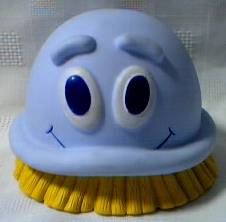
To a more casual and perhaps hungry observer, the shape resembles a steamed chinese pork bun...or perhaps a ghost from Pac-ManOr one of those cartoon scrubber bubbles from "Scrubbing Bubbles" bathroom cleaner! Biology! What we know about its biology can literally be summarized here in a few sentences... Based on observations summarized by Mooi (1990) the Bahamian species Conolampas sigsbei lives in the deep-sea, approximately 120-800 m depths where it lives on coarse carbonate sand, made up mainly pf coral and algae fragments, leaving tracks that look like this:
(ecological reconstruction of Conolampas by Echinoblog Art Dept.! Blue=coarse, carbonate sand)
That central opening where the five grooves meet is the mouth. The circular feature on the edge is called the periproct-and is where the anus, etc. is located.
(Conolampas is mooning you!)

These animals use the fine, hair-like spines for both movement and feeding. Although full feeding biology is unknown Conolampas will fill its gut with carbonate grains and small foraminiferans (shelled ameoba) leaving distinctive trails in its wake. The higher number of spines around the edge of the flattened bottom, likely assist in its movement.

Like all echinoderms, tube feet are also present on the 5 ambulacra that are directed towards the mouth. Tube feet are primarily responsible for movement-but also for feeding and respiration.Here are further details of the spines on the surface... And what the "test" (i.e., the body cleaned of spines) looks like.
We know a little bit about
Conolampas' reproductive biology! Like the fact that they aggregate when they spawn. (This is Conolampas sigsbei on the Bahamian slope, image is taken from Young 1994)

Also worth mentioning is a paper by Craig Young, Paul Tyler and Roland Emson (1995) that shows that embryos of this species, during a 12 hour incubation, show the embryos developing most readily at pressures closer to their actual depth range, with increasingly abnormal embryonic development as pressure (and presumably depth) increase.

So, admittedly, we don't know much about these animals -but the fact that you've got these weird trail-making lamp/bun/ghost/scrubber bubble shaped sea urchins roaming around deep-sea sediment and rubble eating who knows what?? That have sexy threesomes/orgies???

THAT is awesome.
And apparently no less then Alexander Agassiz would agree with me!
HAPPY GEEK/NERD PRIDE DAY EVERYONE!!!