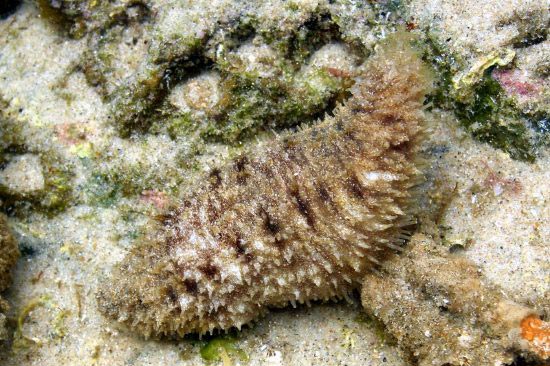
Monday, September 13, 2010

Pteraster & Kin- Starfish that FIGHT BACK with MUCUS!

Everybody LOVES mucus! Yes! Don't deny it!

What would our lives be without it? Dry, boring and unlubricated.


I thought I would kick off the Fall with one of my favoritest and weirdest of echinoderms..
Pteraster and its kin aka the Slime (or Mucus) Stars!!

Who??

Pteraster is one genus in the family Pterasteridae.

This is group of starfishes that includes 8 genera that mostly live in cold-water habitats, but are most diverse in the deep-sea.
The genus Pteraster alone includes about 45 species that occur worldwide, from the Arctic to the Antarctic and all the deep, dark places in between... Many of them eat sponges. So, on the surface, fairly harmless..

We'll be focusing on one particularly well-studied species, Pteraster tesselatus that occurs on the west coast of North America between California and Alaska.

This is a sort of thick, pudgy looking beast that can have a diversity of color patterns...
What makes Pteraster and all of the Pterasteridae so unusual?

The surface of the animal is actually concealed below a tent-like covering [called a SUPRADORSAL MEMBRANE (SD in the figure below)] that extends OVER the animal's proper surface!!

That proper surface below the supradorsal membrane is where you would find the typical features on a sea star's surface, such as the gills and etc..
Here is a cross-section through the arm. Tube feet on the bottom.
Why is this important? Well, its through the supradorsal membrane that the SLIME comes out!!

2. The SLIME Star!!
So, let's cut to the chase-Pteraster tesselatus earns its common name "the Slime Star" owing to its ability to defensively SPEW MUCUS when annoyed by unwanted contact (and who wouldn't want to do that??) !! GOBS and GOBS of it.

Note to you grammar types... MUCUS= noun. MUCOUS=adjective!

(this photo from the Stony Brook mar bio page)

This picture illustrates a typical encounter with Pteraster. Pick it up, and the next thing you know...you've got a bucket full of mucus!

Much of the info presented herein was based on studies by James Nance (Texas A&M University) and Lee Braithwaite (Brigham Young University) from some neat papers
in 1979 and 1981 in the Journal of Experimental Marine Biology & Ecology.

How It works!
Within the supradorsal membrane are a VAST number of mucus producing cells both on the surface and throughout pores present all throughout.

When Pteraster feels threatened, water enters the animal via the bottom tube foot grooves and flows throw the body cavity and up into the cavity between the animals' surface and the supradorsal membrane.

Mucus is produced by cells in the supradorsal membrane.
An opening in the supradorsal membrane, called the osculum, which is normally open

suddenly CLOSES


....and all of the little pores in the supradorsal membrane OPENS!!

So, water pressure EXPELS the Mucous-Water mixture out of the supradorsal membrane!!
So..imagine suddenly stopping up the pipes in your bathroom....and watching it all go somewhere else...
ShABLURRRUUUUUBBBBPTTTHHHHHHHH!!!!!! (noise is simulated-Pteraster does not actually make this noise unless you REALLY want it to. Then, go ahead-knock yourself out!)

and you get THIS!
But WHY does it do that? Would could POSSIBLY offend such an innocuous creature? That just wants to sit around eating sponges all day?

On the west coast of North America, starfish ecology usually involves one of these two predatory "bad boys"...

Solaster..usually Solaster dawsoni, which feeds mostly on other starfish.
(One species of Solaster shown here eating a sea cucumber.. pic from the SIMON/NOAA/MBARI)

Solaster (diameter=24 cm) can apparently take up to FOUR DAYS to devour an undefended Pteraster (about 14 cm across)! And that's basically Pteraster being devoured alive!

OR the fearsome Sunflower Star..Pycnopodia helianthoides which usually just SWALLOWS their prey whole! This takes about 2 days to digest...
(photo by Allison Gong, UCSC)

Tests using mucus applied directly to food being eaten by either of these two species almost instantly resulted in the predator moving away VERY quickly.

Lab tests applying mucus to fish and other invertebrates, such as snails and etc. also results in avoidance or outright fatality following extended exposure.

The mucus probably contains saponins or something similar. I've talked about how 0ther starfish species use saponins as a means of discouraging predators here..

What about other Pterasterids?
So, I've mentioned other deep-sea starfish related to Pteraster..such as this Hymenaster from
the deep sea North Pacific, which is practically MADE from clear gelatinous goo!
...and here...(about a foot across)
And if you pick them up? You get the mucous love!
or to say it another way.. "It slimed me!"


But this simple behavior begs a lot of interesting questions.
If the slime is defensive then WHAT PREYS on the other species around the world in the deep sea?
What about the tropical Pacific Euretaster?
Is the slime more or less toxic where specific predators are around?
How has this affected the long term evolution of the Pterasterids?

All questions for another day. Pteraster is interesting for MANY reasons that I haven't even begun to address...

Tuesday, September 7, 2010

Echinoblog Sneak Peek of the Hyperbolic Crochet Reef!


One of the great things about being "the starfish guy" is that people come to you with starfish questions that they don't think anyone else can answer. For the last two weeks, I've been getting some really NEW kinds of questions!

"Can you Identify this?"

Not a hard question... I do this for a living, after all... But then they dropped THIS in front of me!
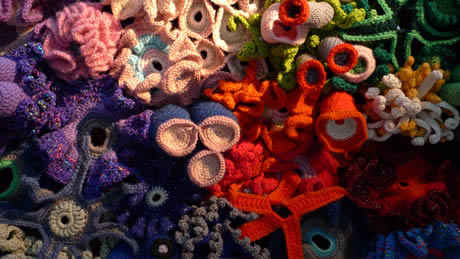
A crocheted tropical reef starfish!

What could it be?? And why was it made?

It turns out that in October, the NMNH will be hosting a satellite "reef" of the Hyperbolic Crochet Coral Reef Project!!!

I have demonstrated my love of knit and crocheted echinoderms before (go here to see)! And am looking forward to seeing this! Especially since I'm seeing what kinds of things are going into it.

Here is the NMNH Crochet Coral Reef Flickr photostream!

There's a detailed background of the whole basis and etc. of the project here but basically, its an international exhibition of crocheted coral reef faunas...the corals themselves as well as affiliated organisms-mostly invertebrates using hyperbolic crochet.

The Project/Exhibition is WORLDWIDE and "satellite" Hyperbolic reefs are on exhibit in Australia, Europe, Africa and eight major cities in the United States!!

The Hyperbolic Crochet Reef will be here in DC at the Smithsonian's National Museum of Natural History from October 16th to April 24th. Click here to see more!
One of my enthusiastic colleagues allowed me to see some crocheted reef corals and echinoderms she had made....

An assemblage of different types..

The aforementioned green sea star...I "identified" as the big tropical Pacific-Atlantic
Linckia guildingi

(this image from the awesome Guam Reef Life website!)

Here is a crocheted Ophiothrix spp. These are ubiquitous throughout the tropical Indo-Pacific and Atlantic and are readily recognizable by the large number of sharp, needle-like spines that adorn the arms. They frequently are observed living among reefs and other colonial cnidarians.
(this is the Indo-Pacific Ophiothrix foveolata, from Wikimedia Commons)

Here is a diadematid, but probably the long-spined black sea urchin Diadema. One of many urchins which are important herbivores feeding on algae while protected by its long-sharp spines.

This next one is near and dear to my heart and has become a beloved echinoblog feature! The Giant Green Fish-eating ophiuroid-Ophiarachna incrassata!!! Which you can go here to see the full story!

Some fun, fuzzy crocheted Fire Urchins (Asthenosoma spp.)!!

A brittle star whose name escapes me...

and here to round out the hyperbolic reef sneak peek are some actual CORAL type things!


...with hopefully more to come!

Tuesday, August 31, 2010

Sea cucumbers got fish that live in their anus and CLAMS that live in their throat! (but not at the same time)

First.. I am now on TWITTER!! Woohoo! Go follow me! (if you dare!)

And now..onto the show...
So, I can only think that it must be just insane to have a sea cucumber's life.

I mean, you got FISH that live in your ANUS. As I wrote about awhile ago...

And NOW... a report about bivalves (i.e., "clams") that live in a sea cucumber's ESOPHAGUS!!!
A 1998 paper by Makoto Kato in the Canadian Journal of Zoology describes several different adaptations of the unusual bivalve endoparasite, Entovalva in three Indo-Pacific sea cucumbers, including Holothuria pardalis.

and Patinapta laevis and P. crosslandi from Guam/Indonesia and Tanzania respectively..

Here's a handy-dandy schematic of where exactly, the clams live..specifically the ESOPHAGUS, which is the muscular region just behind the mouth but just BEFORE the intestine.
(from Echinoblog Art Department!)

So How Does this work??

The shell on Entovalva is actually wrapped INSIDE an extensive fleshy mantle that surrounds it (think of the fleshy covering in geoducks)

Note the Latin genus name "ento" for "inside" and "valva" for valve referring to the shell wrapped inside the mantle...(as seen below)
(Fig. 2 from the paper and from Makoto Kato's website)

These critters actually live in male-female PAIRS..one set per animal!

The female is MUCH larger then the dwarf male (the smaller bit with the male symbol pointing to it in the image above). A feature which is apparently typical for Entovalva.

Another interesting feature is how these clams ATTACH. You know how mussels attach to substrates using these threads? Called BYSSAL threads??

Entovalva uses essentially the same kind of structure, except instead of some rock or bottom, it attatches to the ESOPHAGUS (i.e, the muscular wall) of the host! In this case... the sea cucumber Holothuria pardalis! (seen below)

Kato argues that there are adaptive reasons for this species to be living in the esophogus, rather then say, the guts and intestine where other parasites might live.

One reason? Is to avoid stomach enzymes and other unfriendly substances.. but ALSO to possibly avoid evisceration! That oh-so-delightful part of holothurian defenses that involves the deliberate expulsion of its guts and viscera as a defense mechanism against predators. Such as what its doing here...


Some workers have speculated that some cukes will also eviscerate to "clear out" the parasites in the body cavity.

This isn't something that is universal for all species..but in any case, for a clam to be stuck up in essentially the sea cucumber's esophagus you avoid this particular complication!

So (as I would ask if I had a clam living in my throat) What's it doing there??

Good question.

Often times, when you see internal parasites (or commensals that live inside another organism's body cavity), such as tapeworms or nematodes, the external surface of their bodies have become featureless!!

Why? because if you're living inside a host, the surviving members are best evolved or adapted to their environment INSIDE of a gut or body cavity.

Internal parasites like nematode worms (below) are often featureless (presumably so as not to get caught on items passing through) and have begun to absorb food across their body surface. What sorts of structures have been "lost"? Eyes? If parasites live in the darkness of an intestine all their lives..who needs em? And if it ever had legs, well, it doesn't move much..so those would be gone as well.. etc., etc.

Unlike true parasites, Entovalva remains fully developed!
Consider that in conjunction with the fact that most bivalves are filter feeders...that is, they suck water in, filter food and gases over their gills and spit it back out.
So, these bivalves LIVE in the region right behind the mouth. Water and food passes through this space..so, what happens is this: these bivalves take advantage of the water current and pick out food as the water flows from the mouth into the intestine. (at no apparent loss of nutrition to the host).

This is incidentally why these are considered "endo-symbiotic" rather then parasitic-no harm comes to the host.
The eggs and larvae of these bivalves are located in the mantle and get released FROM the mantle in the esophagus through the intestine and out the anus...

Where they get dropped into the sediment and are presumably picked up by the next appropriate sea cucumber host...

Ah..aint' life grand!

I've yet to hear of a single species that has BOTH the fish in the anus and the clams in the esophagus! But wow. Wouldn't THAT be awesome!