Showing posts with label Holothuroidea. Show all posts

Tuesday, August 31, 2010

Sea cucumbers got fish that live in their anus and CLAMS that live in their throat! (but not at the same time)

First.. I am now on TWITTER!! Woohoo! Go follow me! (if you dare!)

And now..onto the show...
So, I can only think that it must be just insane to have a sea cucumber's life.

I mean, you got FISH that live in your ANUS. As I wrote about awhile ago...

And NOW... a report about bivalves (i.e., "clams") that live in a sea cucumber's ESOPHAGUS!!!
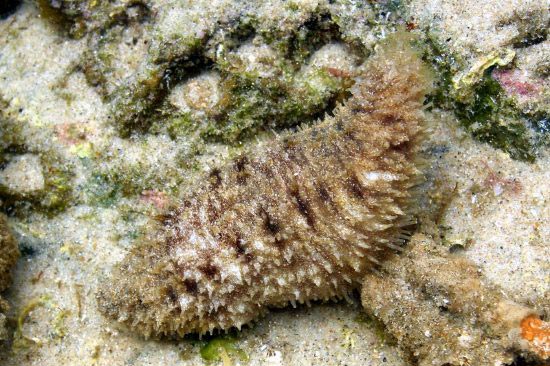
A 1998 paper by Makoto Kato in the Canadian Journal of Zoology describes several different adaptations of the unusual bivalve endoparasite, Entovalva in three Indo-Pacific sea cucumbers, including Holothuria pardalis.

and Patinapta laevis and P. crosslandi from Guam/Indonesia and Tanzania respectively..

Here's a handy-dandy schematic of where exactly, the clams live..specifically the ESOPHAGUS, which is the muscular region just behind the mouth but just BEFORE the intestine.
(from Echinoblog Art Department!)

So How Does this work??

The shell on Entovalva is actually wrapped INSIDE an extensive fleshy mantle that surrounds it (think of the fleshy covering in geoducks)

Note the Latin genus name "ento" for "inside" and "valva" for valve referring to the shell wrapped inside the mantle...(as seen below)
(Fig. 2 from the paper and from Makoto Kato's website)

These critters actually live in male-female PAIRS..one set per animal!

The female is MUCH larger then the dwarf male (the smaller bit with the male symbol pointing to it in the image above). A feature which is apparently typical for Entovalva.

Another interesting feature is how these clams ATTACH. You know how mussels attach to substrates using these threads? Called BYSSAL threads??

Entovalva uses essentially the same kind of structure, except instead of some rock or bottom, it attatches to the ESOPHAGUS (i.e, the muscular wall) of the host! In this case... the sea cucumber Holothuria pardalis! (seen below)

Kato argues that there are adaptive reasons for this species to be living in the esophogus, rather then say, the guts and intestine where other parasites might live.

One reason? Is to avoid stomach enzymes and other unfriendly substances.. but ALSO to possibly avoid evisceration! That oh-so-delightful part of holothurian defenses that involves the deliberate expulsion of its guts and viscera as a defense mechanism against predators. Such as what its doing here...


Some workers have speculated that some cukes will also eviscerate to "clear out" the parasites in the body cavity.

This isn't something that is universal for all species..but in any case, for a clam to be stuck up in essentially the sea cucumber's esophagus you avoid this particular complication!

So (as I would ask if I had a clam living in my throat) What's it doing there??

Good question.

Often times, when you see internal parasites (or commensals that live inside another organism's body cavity), such as tapeworms or nematodes, the external surface of their bodies have become featureless!!

Why? because if you're living inside a host, the surviving members are best evolved or adapted to their environment INSIDE of a gut or body cavity.

Internal parasites like nematode worms (below) are often featureless (presumably so as not to get caught on items passing through) and have begun to absorb food across their body surface. What sorts of structures have been "lost"? Eyes? If parasites live in the darkness of an intestine all their lives..who needs em? And if it ever had legs, well, it doesn't move much..so those would be gone as well.. etc., etc.

Unlike true parasites, Entovalva remains fully developed!
Consider that in conjunction with the fact that most bivalves are filter feeders...that is, they suck water in, filter food and gases over their gills and spit it back out.
So, these bivalves LIVE in the region right behind the mouth. Water and food passes through this space..so, what happens is this: these bivalves take advantage of the water current and pick out food as the water flows from the mouth into the intestine. (at no apparent loss of nutrition to the host).

This is incidentally why these are considered "endo-symbiotic" rather then parasitic-no harm comes to the host.
The eggs and larvae of these bivalves are located in the mantle and get released FROM the mantle in the esophagus through the intestine and out the anus...

Where they get dropped into the sediment and are presumably picked up by the next appropriate sea cucumber host...

Ah..aint' life grand!

I've yet to hear of a single species that has BOTH the fish in the anus and the clams in the esophagus! But wow. Wouldn't THAT be awesome!

Tuesday, May 11, 2010

When Fish Live in your Cloaca & How Anal Teeth are Important!! The Pearlfish-Sea Cucumber Relationship!

Have you ever had one of those days when you just suddenly started thinking about fish that live in the rectal cavities of sea cucumbers?

Well, if you weren't before GET READY!!! Cause' THAT is what we're talkin' bout TODAY!

What ARE you talking about???
Okay, so in the tropical coral reefs of the Pacific and Atlantic you've got these BIG sea cucumbers (up to about 1 to 2 FEET long!) that digest sediment like earthworms, picking up sediment and digesting the organic particles-like this one:

Thelenota ananas


And others like Bohadschia argus and other species...

PLUS you've got these fish in the family Carapidae-common name The Pearlfishes.. such as those in the genus Carapus...

AND these fish live in the cloacas (aka the nearby rectal space) and body cavities of sea cucumbers!

WHAT? That's disgusting!

Maybe.

but its also pretty dang cool! Let's see how this relationship works!

Info on this came from Parmentier & Vandewalle (2005), Parmentier & Das (2004), and Trott (1981). There's a LOT of complexity to this relationship and undoubtedly I will be adding more to the relatively boiled down version here...

So, How Does This uh...relationship work??? First. Physical dynamics.

Sea cucumbers are big fleshy bags full of water and guts. As illustrated here, courtesy of the Tree of Life...
If we simplify that a bit to this (drawn by Echinoblog Art Department!):
And then ADD in RED where the fish live...
So, these fish basically LIVE in the cloaca (i.e., the ASS space) of sea cucumbers! Sometimes they're just too big and so, they stick the big forward part of their body OUT of the anal opening! Bear in mind though, that it doesn't take much for these fish to get into the body coelom or other parts of the sea cucumber host!!

This is what's classically considered a COMMENSAL or as we'll, see sometimes even a parasitic relationship.

The truly commensal pearlfish species apparently feed on crustaceans, using the holothurian's cloacal space as protection...

For additional reasons outlined below, its thought that living within sea cucumbers is adaptive because it confers protection for the pearlfish.

Some dynamics:
  • One or sometimes two animals (male and female when that is the case) will geneally live in a single host sea cucumber.
  • Pearlfish live in the cloaca but can also live in the actual body cavity (i.e., coelom) and what's called the respiratory tree-a bunch of tubular branches that comes off the cloaca (in the diagram above in blue). Sea cucumbers use this structure to extract oxygen.
  • Pearlfish seek out the cloacal opening of the host and then work their way INTO the anus sometimes head first or sometimes tail first, working themselves backwards into the anus of the sea cucumber. This latter tail first method is used 80% of the time.
  • Larger pearlfish are found in larger host sea cucumbers.
  • Only SOME species of pearlfish are commensals in certain species of sea cucumbers. Some are free living and others are not...
SOME pearlfish such as Encheliophis

are actually PARASITIC on sea cucumbers. So, not only do these pearlfishes LIVE in the cloaca/body space/whatever, these little buggers will actually EAT tissues from inside the cucumber, including the gonads, various viscera, and body wall muscles-basically ANY tissue that seems convenient... Yikes! Talk about a bad houseguest!


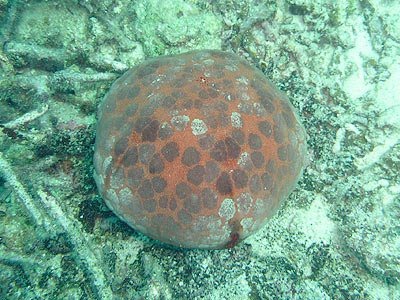
...sometimes they ALSO live in the huge body cavity of the giant cushion stars (Culctia novaeguineae) or even crown of thorns! (Acanthaster planci)
Which as we've seen in prior posts...have just a PALATIAL coelom filled with water and guts-easily accessible via the tube foot groove!!
Parasitic pearlfish species inside starfish will devour tube feet, stomach tissue, gonads, digestive organs, and etc... in the same way they would on sea cucumbers...

But WHAT do any of these fish GET OUT OF THE HOST ANYWAY??? Some thoughts by Parmentier & Vandewalle (2005) include...

Reproduction
  • The commensal Carapus doesn't get food from the host-so what benefit comes?? It turns out that that Carapus spp. may use their host not only as habitat but MAY also as a place to REPRODUCE!! (remember that when two are present you have males and females present!)
  • Its suggested that males and females do teh Sex INSIDE the sea cucumber. The eggs are released via the water currents through the respiratory tree and anus into the water. The juveniles are carried by currents to the open ocean before hatching.
Protection
It turns out that some pearlfish, such as Carapus actually have increased resistance to the sticky toxins produced by Culverian tubules, which many tropical sea cucumber species spurt out and use to defend themselves...like this one...


but the Culverian tubules only seem to react when threats to the external surface of the holothurian are at play!

The intrusion of pearlfish into the cloaca of the sea cucumber? DOES NOT SET OFF the defensive response!!
Is it possible that the sea cucumber hosts are chosen because of their built in defense systems against predators??? What fish wouldn't want to live in a giant sticky-guts shooting house??


One final word, if these fish do so well, then why aren't all species of holothurians (aka sea cucumbers) occupied by pearlfish??

To put it simply, there may simply NOT be the space that permits oxygen respiration for all species...Some pearlfish species are thought to be KEPT out of occupying some large sea cucumber species.

How might that be accomplished?

Two Words: ANAL TEETH.

These structures protect the anus and the cloacal space!

AND as a personal bit of good advice? Don't look up the term "Anal Teeth" on Google Image without the safeties on! It can be....traumatic...

Monday, February 8, 2010

Winter Interlude pt. 1: Tropical Holothurians (sea cucumbers) from tropical Fiji!

Greetings to everyone! So, some of you may have heard about the trivial bout of weather we've been having with more to come! Life has been snow! snow! snow! for the last week or so..
I have literally been snowed out of the museum for the last few days!
(photo by Jim Diloreto USNM)

Enter Posa Skelton, the Coordinator of the Pacific Islands Network for Taxonomy, who is based in Fiji and had many pictures of sea stars to identify and other echinoderms to share!

Just the thing to break up the winter monotony!
So, today: TROPICAL SEA CUCUMBERS from FIJI!!

UPDATE!!!! The knowledgeable Dr. Alex Kerr at the University of Guam has provided me with up to date identifications of the animals below!!! Enjoy them with authoritative confidence!!

Yeeha!!

Bohadschia vitiensis (Cuverian tubules are being emitted as a defence!!)
The oh-so sexy Holothuria (Halodeima) edulis
Actinopyga echinites

Stichopus herrmanii (and probably the one below it also) Pearsonothuria graeffei
Holothuria (Microthele) fuscopunctata (and the one below it)Holothuria (Microthele) whitmaei
Stichopus chloronotus
WITH MORE TROPICAL ECHINODERMS LATER THIS WEEK!!