I'm not sure why..but for some reason there's a TON of awesome sexy shrimp-sea urchin commensal love videos floatin' round the Internets this week!!
Go Forth and be amazed!!
A shrimp that the videographer-the awesome Morphologic Studios identifies as Gnathophylloides mineri on the Caribbean "sea egg" Tripneustes ventricosus...
Morphologic studios shot this amazing footage of a "pea crab" (Dissodactylus primitivus)(length=7.0 mm!) on the heart urchin Meoma ventricosus!
A tiny shrimp on what looks like a fire urchin..
Here's a little guy in what looks like a diadematid urchin..with just some stunning video..
What looks like the same species...of shrimp/urchin...
I'm guessing this is a decorator crab that has added a fire urchin (Astropyga?) as it makes a break for it across an open plain...
Oddly enough here's another person with video of the SAME thing...
Showing posts with label commensalism. Show all posts
Showing posts with label commensalism. Show all posts
Tuesday, August 24, 2010

Tuesday, May 11, 2010
When Fish Live in your Cloaca & How Anal Teeth are Important!! The Pearlfish-Sea Cucumber Relationship!

Have you ever had one of those days when you just suddenly started thinking about fish that live in the rectal cavities of sea cucumbers?
Well, if you weren't before GET READY!!! Cause' THAT is what we're talkin' bout TODAY!
Well, if you weren't before GET READY!!! Cause' THAT is what we're talkin' bout TODAY!
What ARE you talking about??? Okay, so in the tropical coral reefs of the Pacific and Atlantic you've got these BIG sea cucumbers (up to about 1 to 2 FEET long!) that digest sediment like earthworms, picking up sediment and digesting the organic particles-like this one:
Thelenota ananas

And others like Bohadschia argus and other species...

PLUS you've got these fish in the family Carapidae-common name The Pearlfishes.. such as those in the genus Carapus...

AND these fish live in the cloacas (aka the nearby rectal space) and body cavities of sea cucumbers!
WHAT? That's disgusting!
Maybe.
but its also pretty dang cool! Let's see how this relationship works!
Info on this came from Parmentier & Vandewalle (2005), Parmentier & Das (2004), and Trott (1981). There's a LOT of complexity to this relationship and undoubtedly I will be adding more to the relatively boiled down version here...
So, How Does This uh...relationship work??? First. Physical dynamics.
Sea cucumbers are big fleshy bags full of water and guts. As illustrated here, courtesy of the Tree of Life...
 If we simplify that a bit to this (drawn by Echinoblog Art Department!):
 And then ADD in RED where the fish live...
 So, these fish basically LIVE in the cloaca (i.e., the ASS space) of sea cucumbers! Sometimes they're just too big and so, they stick the big forward part of their body OUT of the anal opening! Bear in mind though, that it doesn't take much for these fish to get into the body coelom or other parts of the sea cucumber host!!
This is what's classically considered a COMMENSAL or as we'll, see sometimes even a parasitic relationship.

The truly commensal pearlfish species apparently feed on crustaceans, using the holothurian's cloacal space as protection...
For additional reasons outlined below, its thought that living within sea cucumbers is adaptive because it confers protection for the pearlfish.
Some dynamics:
- One or sometimes two animals (male and female when that is the case) will geneally live in a single host sea cucumber.
- Pearlfish live in the cloaca but can also live in the actual body cavity (i.e., coelom) and what's called the respiratory tree-a bunch of tubular branches that comes off the cloaca (in the diagram above in blue). Sea cucumbers use this structure to extract oxygen.
- Pearlfish seek out the cloacal opening of the host and then work their way INTO the anus sometimes head first or sometimes tail first, working themselves backwards into the anus of the sea cucumber. This latter tail first method is used 80% of the time.
- Larger pearlfish are found in larger host sea cucumbers.
- Only SOME species of pearlfish are commensals in certain species of sea cucumbers. Some are free living and others are not...

are actually PARASITIC on sea cucumbers. So, not only do these pearlfishes LIVE in the cloaca/body space/whatever, these little buggers will actually EAT tissues from inside the cucumber, including the gonads, various viscera, and body wall muscles-basically ANY tissue that seems convenient... Yikes! Talk about a bad houseguest!
...sometimes they ALSO live in the huge body cavity of the giant cushion stars (Culctia novaeguineae) or even crown of thorns! (Acanthaster planci)
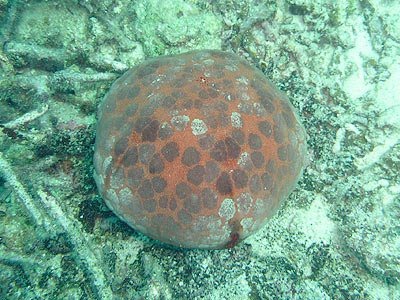 Which as we've seen in prior posts...have just a PALATIAL coelom filled with water and guts-easily accessible via the tube foot groove!!
 Parasitic pearlfish species inside starfish will devour tube feet, stomach tissue, gonads, digestive organs, and etc... in the same way they would on sea cucumbers...
But WHAT do any of these fish GET OUT OF THE HOST ANYWAY??? Some thoughts by Parmentier & Vandewalle (2005) include...
Reproduction
- The commensal Carapus doesn't get food from the host-so what benefit comes?? It turns out that that Carapus spp. may use their host not only as habitat but MAY also as a place to REPRODUCE!! (remember that when two are present you have males and females present!)
- Its suggested that males and females do teh Sex INSIDE the sea cucumber. The eggs are released via the water currents through the respiratory tree and anus into the water. The juveniles are carried by currents to the open ocean before hatching.
It turns out that some pearlfish, such as Carapus actually have increased resistance to the sticky toxins produced by Culverian tubules, which many tropical sea cucumber species spurt out and use to defend themselves...like this one...
but the Culverian tubules only seem to react when threats to the external surface of the holothurian are at play!
The intrusion of pearlfish into the cloaca of the sea cucumber? DOES NOT SET OFF the defensive response!!
Is it possible that the sea cucumber hosts are chosen because of their built in defense systems against predators??? What fish wouldn't want to live in a giant sticky-guts shooting house??
One final word, if these fish do so well, then why aren't all species of holothurians (aka sea cucumbers) occupied by pearlfish??
To put it simply, there may simply NOT be the space that permits oxygen respiration for all species...Some pearlfish species are thought to be KEPT out of occupying some large sea cucumber species.
How might that be accomplished?
Two Words: ANAL TEETH.

These structures protect the anus and the cloacal space!
AND as a personal bit of good advice? Don't look up the term "Anal Teeth" on Google Image without the safeties on! It can be....traumatic...
Tuesday, March 9, 2010
Is it Love? Mutualism in Leather Stars (Dermasterias) and Scale Worms (Arctonoe)!!

So, with all this talk of Invertebrate Blog War, I thought I would veer away from all of that and instead talk about the more positive relationships that are observed between two different phyla of invertebrates.
This is based on a paper by Wagner et al. 1979 that details the relationship between two species that are found all along the west (Pacific) Coast of North America.
One of them is this species, a sea star, Dermasterias imbricata, aka the Leather Star or the Garlic Star.
AND along with it is a worm. A member of the Polynoidae called Arctonoe, species- A. vittata.

This worm lives in the tube foot grooves of Dermasterias. They basically take residence in the spaces between the tube feet and make themselves at home in all of the open space.


This relationship was observed by many of the early Pacific coast naturalists and was labelled commensalism, that is two species that lived together but neither species had either loss or gain. Kind of a "roommates that pass in the night" kind of arrangement.
Here's a cool video that shows the worm ON the underside of the leather star and in/around the animal's tube foot groove.
These worms are commensal in MANY other marine invertebrates. That includes this limpet (in the red circle)

as well as other species of sea stars, and the giant gumboot chiton that lives on the west coast of North America...
These worms have apparently been shown to be chemically attracted to their hosts.
This doesn't really come as a surprise. If they live in the "house" that one of these species provides, then they should know how to find it.
But how far gone is the relationship between this worm and its host???
Wagner et al. wanted to know the extent to which Dermasterias (the starfish) were attracted to the worms in a "Y-shaped" aquatic maze. It was basically given a choice of the worm in one arm (A) versus control (B)..
Which arm of the maze would Dermasterias choose?
 The worms have been shown to move toward their sea star host, but in the total number of trials... Amazingly in 16/20 trials, the sea stars also moved towards the WORM!
They also changed variables. They switched out the commensal worm with a free-living worm, other food items, the sea anemone Anthopleura. And even more amazing??

 The sea stars PREFER the commensal OVER its favorite food item!
Another curious dynamic?? The stars will take the worms REGARDLESS of which host it lived in! They removed one from a limpet, placed it into the maze, and voila! The sea star STILL likes the worm !
So, its not so much a commensal relationship but a MUTUAL one!! Both of them get something out of it!So...Why? What makes the starfish WANT a worm living in its tube foot groove and in/among its parts?
Wagner et al. speculate that this is tied to the worm feeding on either mucus, detritus or other prey.
Curiously, they notice that the worms might be hanging out on starfish that LACK pedicellariae, which are pincers or clamp-like stuctures that starfish use to remove surface detritus/defence etc.
 As an end note, they caution that the experimental results aren't necessarily an indication of what is "real" in the wild. So, one hopes that someday, someone will pick up this study and follow up on these curious relationships, not to mention the other species that harbor these worms!
Subscribe to:
Posts (Atom)