Tuesday, May 11, 2010

When Fish Live in your Cloaca & How Anal Teeth are Important!! The Pearlfish-Sea Cucumber Relationship!

Have you ever had one of those days when you just suddenly started thinking about fish that live in the rectal cavities of sea cucumbers?

Well, if you weren't before GET READY!!! Cause' THAT is what we're talkin' bout TODAY!

What ARE you talking about???
Okay, so in the tropical coral reefs of the Pacific and Atlantic you've got these BIG sea cucumbers (up to about 1 to 2 FEET long!) that digest sediment like earthworms, picking up sediment and digesting the organic particles-like this one:

Thelenota ananas


And others like Bohadschia argus and other species...

PLUS you've got these fish in the family Carapidae-common name The Pearlfishes.. such as those in the genus Carapus...

AND these fish live in the cloacas (aka the nearby rectal space) and body cavities of sea cucumbers!

WHAT? That's disgusting!

Maybe.

but its also pretty dang cool! Let's see how this relationship works!

Info on this came from Parmentier & Vandewalle (2005), Parmentier & Das (2004), and Trott (1981). There's a LOT of complexity to this relationship and undoubtedly I will be adding more to the relatively boiled down version here...

So, How Does This uh...relationship work??? First. Physical dynamics.

Sea cucumbers are big fleshy bags full of water and guts. As illustrated here, courtesy of the Tree of Life...
If we simplify that a bit to this (drawn by Echinoblog Art Department!):
And then ADD in RED where the fish live...
So, these fish basically LIVE in the cloaca (i.e., the ASS space) of sea cucumbers! Sometimes they're just too big and so, they stick the big forward part of their body OUT of the anal opening! Bear in mind though, that it doesn't take much for these fish to get into the body coelom or other parts of the sea cucumber host!!

This is what's classically considered a COMMENSAL or as we'll, see sometimes even a parasitic relationship.

The truly commensal pearlfish species apparently feed on crustaceans, using the holothurian's cloacal space as protection...

For additional reasons outlined below, its thought that living within sea cucumbers is adaptive because it confers protection for the pearlfish.

Some dynamics:
  • One or sometimes two animals (male and female when that is the case) will geneally live in a single host sea cucumber.
  • Pearlfish live in the cloaca but can also live in the actual body cavity (i.e., coelom) and what's called the respiratory tree-a bunch of tubular branches that comes off the cloaca (in the diagram above in blue). Sea cucumbers use this structure to extract oxygen.
  • Pearlfish seek out the cloacal opening of the host and then work their way INTO the anus sometimes head first or sometimes tail first, working themselves backwards into the anus of the sea cucumber. This latter tail first method is used 80% of the time.
  • Larger pearlfish are found in larger host sea cucumbers.
  • Only SOME species of pearlfish are commensals in certain species of sea cucumbers. Some are free living and others are not...
SOME pearlfish such as Encheliophis

are actually PARASITIC on sea cucumbers. So, not only do these pearlfishes LIVE in the cloaca/body space/whatever, these little buggers will actually EAT tissues from inside the cucumber, including the gonads, various viscera, and body wall muscles-basically ANY tissue that seems convenient... Yikes! Talk about a bad houseguest!


...sometimes they ALSO live in the huge body cavity of the giant cushion stars (Culctia novaeguineae) or even crown of thorns! (Acanthaster planci)
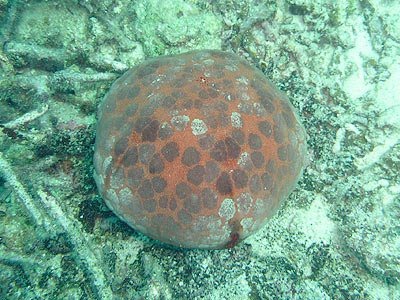
Which as we've seen in prior posts...have just a PALATIAL coelom filled with water and guts-easily accessible via the tube foot groove!!
Parasitic pearlfish species inside starfish will devour tube feet, stomach tissue, gonads, digestive organs, and etc... in the same way they would on sea cucumbers...

But WHAT do any of these fish GET OUT OF THE HOST ANYWAY??? Some thoughts by Parmentier & Vandewalle (2005) include...

Reproduction
  • The commensal Carapus doesn't get food from the host-so what benefit comes?? It turns out that that Carapus spp. may use their host not only as habitat but MAY also as a place to REPRODUCE!! (remember that when two are present you have males and females present!)
  • Its suggested that males and females do teh Sex INSIDE the sea cucumber. The eggs are released via the water currents through the respiratory tree and anus into the water. The juveniles are carried by currents to the open ocean before hatching.
Protection
It turns out that some pearlfish, such as Carapus actually have increased resistance to the sticky toxins produced by Culverian tubules, which many tropical sea cucumber species spurt out and use to defend themselves...like this one...


but the Culverian tubules only seem to react when threats to the external surface of the holothurian are at play!

The intrusion of pearlfish into the cloaca of the sea cucumber? DOES NOT SET OFF the defensive response!!
Is it possible that the sea cucumber hosts are chosen because of their built in defense systems against predators??? What fish wouldn't want to live in a giant sticky-guts shooting house??


One final word, if these fish do so well, then why aren't all species of holothurians (aka sea cucumbers) occupied by pearlfish??

To put it simply, there may simply NOT be the space that permits oxygen respiration for all species...Some pearlfish species are thought to be KEPT out of occupying some large sea cucumber species.

How might that be accomplished?

Two Words: ANAL TEETH.

These structures protect the anus and the cloacal space!

AND as a personal bit of good advice? Don't look up the term "Anal Teeth" on Google Image without the safeties on! It can be....traumatic...

Tuesday, May 4, 2010

Spiny Skinned "Canaries" in a Coal Mine? The Gulf Oil Spill & the Impact on Echinoderms!


Sadly, much of the ecological and marine biology news over the last week has been dominated by the huge oil spill threatening the Gulf of Mexico.
Comprehensive accounts of this event are nicely summarized by my friends over at Deep Sea News here and here.

A great deal of the public media coverage will show you heartbreaking images of turtles, seabirds, and other charismatic vertebrates that will be harmed by this ecological catastrophe.

But the sad truth is that some of the animals which will be hit worst by the oil spill will probably be invertebrates. A general overview of the effect of oil on marine invertebrate communities can be found here.

Echinoderms are exclusively MARINE invertebrates, that is they ONLY live in the ocean (none in freshwater or terrestrial). There are relatively few invertebrate groups that can make that claim.

And as such, they are VERY sensitive to environmental changes. Are they the spiny, marine equivalent of the "canary in a coal mine"?
Echinoderms need reasonably good quality seawater to survive...and so, if they aren't getting that, then its safe to say that things aren't well. There's a physiological basis for that-and I'll get into that in a bit...

So, what kinds of impacts/effects will we see as crude oil spills impact the marine invertebrate communities in the Gulf of Mexico??

1. Marine Larvae will be Badly Affected. So, many if not most marine invertebrates go through a small free-floating, free-living or swimming larval stage that live in the water column.
(Photo courtesy Allison Gong)

These larvae then undergo a transformation from the larvae into a juvenile and eventually into an adult. A good photo essay of this can be seen here.

So, can happen if you saturate the water with crude oil?
A variety of possible effects:
1. Death. The oil adheres and smothers the larvae which prevents respiration, movement, creates excess weight. Not to mention the toxic effects of other chemical additives. I would imagine that there can be fairly severe larval dieoffs.

2. Defects. Some studies on purple sea urchins have shown that even minor petroleum hydrocarbons can lead to "cytogenic or cytologic anomalies". Oil can affect the larval development stage at any number of critical stages

a. It can affect abilities of the larvae to settle (including discovering settlement sites)
b. It can affect attachment of that larvae to the bottom or wherever it wants to "live" as an
adult.

c. Stunts growth and ability to mature.

d. Inability to defend against/avoid predators.

    2. Oil Impacts on the ADULT animals.... So that was larvae. Larvae are tiny (about 1mm if even that!) But starfish are BIG!!

    How specifically are adult echinoderms vulnerable to oil spills?

    Echinoderms don't do well with toxic substances.... Following a paper by Michel Jangoux (1984) and others.. a massive oil spill can "destroy echinoderm populations", sometimes for years...

    Here's why....

    Most other animals you might think of....crabs, clams, snails, worms, fish, etc. , they have internal, self-regulating kidneys, livers, and etc. that maintain a certain level of internal body chemistry that is healthy for the animal.

    Unlike these other animals, echinoderms have bodies that are functionally open to seawater. Effectively echinoderms have HUGE amounts of surface area because water enters from the tube feet, the madreporite and other places throughout the body. The internal body of echinoderms are essentially in constant contact with their surroundings.

    Echinoderms constantly pump essentially SEAWATER in and out of their bodies to fuel their water vascular system (i.e., their tube feet and locomotory apparatus). Millions of tiny hair like structures called CILLIA beat and create a current over the surface of the body that drive gas exchange and carry away toxins.

    SO, something like crude oil would physically smother and adhere to the cilia and other body surfaces as well as block respiration (gas exchange) on the body surface.

    That's not to mention the other toxic effects which the animal would be unable to remove because the oil would be clogging/blocking/interfering with the natural way the animal regulates the removal of foreign substances.

    Chemical adhesion in tube feet would be blocked by oil and rendered ineffective.

    This specific dependence on fresh non-toxic seawater has always been part of echinoderms' fundamental biology. They often have great sensitivity of the water around them. Speaking from experience, one doesn't usually see echinoderms where water quality is anything less then optimal.

    Some have gone so far as to interpret this intrinsic link to seawater as the reason why echinoderms have never exploited freshwater and terrestrial habitats or other settings where regulating toxic substances is crucial.

    Also, this is POSSIBLY why echinoderms are generally absent from natural settings where toxic chemicals are present, such as hydrothermal vents or cold seeps and is likely why crude oil SO adversely affects echinoderm biology.

    Could Echinoderms Provide Insight as to Some Short-Term Solutions?

    One interesting experiment that exposed oil products to echinoderms was this paper by Georgiades et al., (2003) which studied oil-derived substances and determined their impact on the commonly encountered Australian asteriid starfish Coscinasterias muricata.
    (Coscinasterias muricata image from PaDIL Australia)

    So, it was pretty clear that oil was going to act as a stressor on these animals..and that's what they saw...the appetite and ability to locate food was affected as well as the stars' ability to right themselves when turned upside down.

    But they applied three different oil-based substances including...
    • pure crude oil,
    • "dispersed oil" (i.e., oil that had been chemically treated to break up)
    • and burnt oil (i.e., oil that had been set on fire and allowed to burn out)
    Crude oil and the dispersed oil resulted in the greatest negative impact. And in fact, dispersive chemicals were actually MORE toxic then crude oil itself..

    Interestingly, the BURNT oil residue created the weakest impact. Their conclusions go on to support that the strategy of burning oil might be the best insofar as the effect of that residue on Coscinasterias (and by extension-other starfish or echinoderms) following the burn....

    But bear in mind,
    this experiment was performed in a lab with isolated oil products. An actual burn would involve, you know..FIRE, smoke and other toxic substances that echinoderms aren't likely to handle well..

    So..in Conclusion..
    things don't look good for the great diversity of echinoderms and/or other marine invertebrates in the Gulf given the increasingly growing oil slick problem.

    Echinoderms might be a little more vulnerable and more different then other marine invertebrates...but they are often regarded as the "model animal" for how certain marine invertebrates will fare.....and based on other studies, its probably not unreasonable to predict a massive die-off of not just echinoderms...but other marine invertebrates.

    Tuesday, April 27, 2010

    The world's OLDEST MULTI-ARMED Starfish!! A lesson in Starfish Evolution!


    (note that the scale bar is 10.0 mm)


    Today, a cool post with contributions from my colleague Dr. Liam Herringshaw, currently a postdoc at the Memorial University of Newfoundland in Canada!

    and he's written two very interesting papers on the OLDEST known multi-armed starfish! Most of this blog post is based on this paper in the Zoological Journal of the Linnean Society. But he's also written this paper in Paleontology about the fossil starfish diversity from the Silurian of England.


    So people know that MOST starfish have five arms. But a bunch of starfish species all over the world have 6 ore even more arms..many have about 10-15 arms..up to 50 in the Antarctic Labidiaster.


    Among the better known of these is the predatory Sunflower star (Pycnopodia helianthoides) from the west coat of North America....

    Multi-armed starfish occur in tropical (for example, Coronaster) and cold-water (for example, Labidiaster or Solaster) environments as well as in shallow-water (Coscinasterias or Pycnopodia) and deep-water habitats (for example, the Pacific California Rathbunaster or the brisingids).


    Liam's PhD work focused on, among other things, fossil starfish from Silurian deposits (about 444 million years ago) in the English Midlands and Welsh Borderlands. His work introduced him to this amazing beast..

    The legendary Manx naturalist Edwin Forbes described the fossil in 1850 (this is the Forbes for whom the Atlantic starfish Asterias forbesi is named), calling it Lepidaster grayi.


    The name is composed of the Ancient Greek for "scale"...Lepidos and -aster for "star" for the scale-like body elements. Forbes named the species for John Gray, one of Forbes' colleagues and fellow scientists.


    Based on Liam's accounts, it apparently not clear to Forbes if his fossil was even a starfish!

    As author-illustrator of the definitive British guide, Forbes knew his living starfish, but this fossil baffled him. At first it reminded him of the common sun star Crossaster papposus, individuals of which often have 13 arms, but Forbes began to have his doubts. Was this palæontological oddball even a starfish at all? Could it be the missing link between starfish and sea lilies, their many-armed cousins?

    Liam's paper breaks down the evolutionary importance of Lepidaster and what it means to be a PALEOZOIC multi-armed starfish! Let's go through the major points!


    1. This is the earliest fossil where we find multi- armed starfish in the Fossil Record!

    If we were to compare this to vertebrates, this might be like looking at all of the mammals, turtles, lizards, snakes, dinosaurs, crocodiles, etc. and trying to find the very FIRST time that something stood up and walked around regularly on two legs. A minority of mammals do it today-but wouldn't it be interesting if some OTHER species did it before??


    So, multiple arms is a recurring evolutionary theme in sea stars. Most have five-but it occurs over and over across very different evolutionary lineages. More on this below under #2...


    This tree basically shows APPROXIMATELY where Lepidaster is placed relative to modern starfishes and how far away from the starfishes you see in the oceans today would be from something fossil like Lepidaster.


    2. Multiple Arms appear Multiple Times in the Evolution of Starfishes!


    So, not only did multiple arms appear first, but it is the first of MANY times that we see multiple arms throughout starfish evolution.


    A tree of starfish is below...the "starbursts" on the right give you an idea of all the different evolutionary branches where the multi-armed condition is seen..

    This modified from Blake (1987) taken from the TOL Asteroidea page.


    ...So bottom line is that having multiple arms is the result of what's called CONVERGENT evolution also known as homoplasy.


    That is to say that the SAME body form or structure is seen in two or more completely separate evolutionary lineages. For example, dolphins and whales, superficially resemble fish-with fins and the teardrop body shape, because they live in open ocean/water, etc.... But aside from both being vertebrates, they are NOT directly related.


    The same is often observed in starfish! Having multiple arms works in starfish evolution. A hit that keeps on coming back!


    3. The Ecology. Why have multiple arms?? Was Lepidaster the first??


    Liam has provided some intriguing speculation on the nature of the multi-armed condition...


    Does having extra arms help?

    If the ratio of body size to arm length is kept consistent, but eight extra arms are added, the volume (or biomass) of a multiradiate starfish is roughly double that of a 'normal' form. This means a marked increase in the energy required to keep the animal functioning. If you need more food, there are two ways you can go about getting it. You can out-muscle your competitors for existing food sources, or you can start exploiting new ones. Many starfish with supernumerary rays seem to have taken the latter course of action, from consuming coral,

    to eating other echinoderms, even to scoffing (=eat) fellow starfish.

    Perhaps Gray’s scaly star was the pioneer. With its mouth in the middle of a much larger and more flexible body than that of its contemporaries, it would certainly have been capable of doing something different.

    Herringshaw and his colleagues speculated that Lepidaster might be similar to the solasterid Crossaster. Here for comparison against the mouth shown above is a related solasterid, Heterozonias, (a deep-sea predator) which looks similar...

    To further explore Liam's notion's we often invoke a principle known as uniformitarianism which basically assumes that the "present is the key to the past". In other words, processes that are at work today are those SAME processes that occurred in the past.


    And so, we look to modern starfishes for possible ecology, feeding strategy, and evolutionary ideas about how the multi-armed condition arose.


    Specifically, we look at the functional morphology of modern forms, in other words, any kind of direct behavioral or ecological inference based on the external morphology-like how sharp teeth are used to tear and eat flesh.....something that we hope will surrender clues or provide inference of what the fossil animal's life mode might have been like...


    A good example of different multi-armed species that have a specific ecological function associated with their form are taxa like the Brisingids, who use their arms to pluck food out of the water as suspension feeders. I wrote these up here.

    If we follow up with an example of what a modern predator like Solaster looks like...

    Compared to Lepidaster...

    There's a LOT of differences in the fundamental skeletal structure between these two animals. Bear in mind that ANY similarlities are almost certainly because of convergence! (Solaster is a highly derived modern starfish)


    That being said, the overall form of the body between Lepidaster and solasterids, such as this predatory Arctic sun star Solaster endeca is curiously similar.

    This sort of implies that Lepidaster probably was some kind of predator. But the similar body form COULD be due to some entirely OTHER evolutionary adaptation!


    Thus, the mystery may remain unresolved, barring better fossils preserving catching Lepidaster eating prey (or the unlikely discovery of a living Lepidaster somewhere), BUT we have a much better idea of what this mysterious and intriguing beast was like and considerations about its lifestyle and evolutionary "story".....


    My, grandma starfish, what a lot of arms you have!


    All the better for grabbing you with!


    Why grandma starfish, what a flexible mouth you have!


    All the better for extruding my stomach and smothering you with!


    Thanks again to Liam Herringshaw for his pix and insights-and prose above! (Responsibility for all errors is all mine...)