Monday, May 24, 2010

Conolampas sigsbei- A "living fossil" about which-Little Is Known....

Today, an animal that I greatly admire but about which little is known! The sea urchin CONOLAMPAS!!

What is Conolampas?
Conolampas is a member of the Irregularia, a major subgroup within the Echinoidea aka the Sea Urchins.

The "irregular" sea urchins includes all those which have become modified to live in or on unconsolidated sediment (i.e., mud, dirt, sand, etc.)..Sea
biscuits (spatangoids), and sand dollars (clypeasteroids) are "irregular" sea urchins.
Irregular urchins are unusual in that they have
1. Bilateral symmetry
imposed over their typical echinoderm 5-part symmetry
2. Instead of big, solid rigid spines, they have fine, hair-like spines that are adapted to burrowing or at least, not getting in the way of burrowing...
3. A modified or absent jaw (aka Aristotle's Lantern).
4. An anus and/or mouth moved into different positions relative to "regular" sea urchins.

Irregular urchins live all around the world.

Sand dollars tend to live in shallow habitats whereas sea biscuits (aka spatangoids) live in shallow and deep-sea habitats.

Spatangoids are very diverse and can get VERY weird very quickly...
Conolampas itself is not known from fossils (although some of its close relatives were around during the time of the dinosaurs) and is known from one species in the Atlantic (west indies) and three in the Indo-Pacific.

So, what's cool about Conolampas?

Shape!
The great Echinologist Alexander Agassizi described this animal in 1878 (pg. 190) and named the species after Captain Sigsbee, the commanding officer of the U.S. Coast Survey Steamer Blake which collected the first known specimens of this species.

Agassiz was SO impressed by this critter that the first thing he had to say about it in the original description is this:
This magnificent species is by far the most striking sea urchin I have seen. I shall always remember the particular haul when, on the edge of the Yukatan Bank, the dredge came up containing half a dozen of these huge brilliant lemon-colored Echini.
The overall body shape of this animal looks like this... The top is here...

and as you can see, the bottom actually FLATTENS out..

The scientific name of this animal, Conolampas can be broken down into "Conos" for "Cone shaped" and "lampas" for Lamp...hence.. Cone-shaped Lamp (old fashioned lamps were shaped like this).. (thanks to Kevin Z. and Matt J. for assist with the translation).

To a more casual and perhaps hungry observer, the shape resembles a steamed chinese pork bun...or perhaps a ghost from Pac-ManOr one of those cartoon scrubber bubbles from "Scrubbing Bubbles" bathroom cleaner! Biology! What we know about its biology can literally be summarized here in a few sentences... Based on observations summarized by Mooi (1990) the Bahamian species Conolampas sigsbei lives in the deep-sea, approximately 120-800 m depths where it lives on coarse carbonate sand, made up mainly pf coral and algae fragments, leaving tracks that look like this:

(ecological reconstruction of Conolampas by Echinoblog Art Dept.! Blue=coarse, carbonate sand)
That central opening where the five grooves meet is the mouth. The circular feature on the edge is called the periproct-and is where the anus, etc. is located.
(Conolampas is mooning you!)

These animals use the fine, hair-like spines for both movement and feeding. Although full feeding biology is unknown Conolampas will fill its gut with carbonate grains and small foraminiferans (shelled ameoba) leaving distinctive trails in its wake. The higher number of spines around the edge of the flattened bottom, likely assist in its movement.

Like all echinoderms, tube feet are also present on the 5 ambulacra that are directed towards the mouth. Tube feet are primarily responsible for movement-but also for feeding and respiration.Here are further details of the spines on the surface... And what the "test" (i.e., the body cleaned of spines) looks like.
We know a little bit about
Conolampas' reproductive biology! Like the fact that they aggregate when they spawn. (This is Conolampas sigsbei on the Bahamian slope, image is taken from Young 1994)

Also worth mentioning is a paper by Craig Young, Paul Tyler and Roland Emson (1995) that shows that embryos of this species, during a 12 hour incubation, show the embryos developing most readily at pressures closer to their actual depth range, with increasingly abnormal embryonic development as pressure (and presumably depth) increase.

So, admittedly, we don't know much about these animals -but the fact that you've got these weird trail-making lamp/bun/ghost/scrubber bubble shaped sea urchins roaming around deep-sea sediment and rubble eating who knows what?? That have sexy threesomes/orgies???

THAT is awesome.
And apparently no less then Alexander Agassiz would agree with me!
HAPPY GEEK/NERD PRIDE DAY EVERYONE!!!

Tuesday, May 18, 2010

Battle of the Titans! Starfish Vs. FOOD Videos!!

Agh! Busy this week... But here's some cool videos that demonstrate the diversity of feeding in asteriid starfish!

Marthasterias & that CRUSHING feeling!

Here's the tropical-temperate Atlantic Marthasterias glacialis in the Canary Islands about to devour what I think is Paracentrotus lividus (or some other urchin) using "crushing predation" as described in a recent paper by Gianguzza et al. (2009) in Marine Biology.


Based on their account, this feeding is more then simply using their stomach to devour the soft parts-it uses its body to CRUSH the test (the round "shell" that makes up the body)!! It was previously thought that only fish utilized such a strategy...


Starfish VS. SCALLOP!
Scallops and other shelled mollusks are often prey to asteriid starfish and have VERY strong behavioral responses when they detect them nearby. This has been observed for awhile-for example in this paper by Thomas and Gruffydd (1971).

Here's Marthasterias again..but placed next to the scallop, Pecten maximus. Scallops can SMELL when known predators are nearby..and they can use high pressure jets in their water siphons to escape...like so... But ONLY when specific predatory species are around.


This also looks like Marthasterias...


and here is the North Pacific Sunflower star, Pycnopodia helianthoides doing the same to some Pacific scallop species....


And here is Pycnopodia again! this time harassing what looks like a cockle! Note the extreme escape response as the foot goes into red-alert mode and PUSHES the body away from the oncoming starfish!


More Soon!

Tuesday, May 11, 2010

When Fish Live in your Cloaca & How Anal Teeth are Important!! The Pearlfish-Sea Cucumber Relationship!

Have you ever had one of those days when you just suddenly started thinking about fish that live in the rectal cavities of sea cucumbers?

Well, if you weren't before GET READY!!! Cause' THAT is what we're talkin' bout TODAY!

What ARE you talking about???
Okay, so in the tropical coral reefs of the Pacific and Atlantic you've got these BIG sea cucumbers (up to about 1 to 2 FEET long!) that digest sediment like earthworms, picking up sediment and digesting the organic particles-like this one:

Thelenota ananas


And others like Bohadschia argus and other species...

PLUS you've got these fish in the family Carapidae-common name The Pearlfishes.. such as those in the genus Carapus...

AND these fish live in the cloacas (aka the nearby rectal space) and body cavities of sea cucumbers!

WHAT? That's disgusting!

Maybe.

but its also pretty dang cool! Let's see how this relationship works!

Info on this came from Parmentier & Vandewalle (2005), Parmentier & Das (2004), and Trott (1981). There's a LOT of complexity to this relationship and undoubtedly I will be adding more to the relatively boiled down version here...

So, How Does This uh...relationship work??? First. Physical dynamics.

Sea cucumbers are big fleshy bags full of water and guts. As illustrated here, courtesy of the Tree of Life...
If we simplify that a bit to this (drawn by Echinoblog Art Department!):
And then ADD in RED where the fish live...
So, these fish basically LIVE in the cloaca (i.e., the ASS space) of sea cucumbers! Sometimes they're just too big and so, they stick the big forward part of their body OUT of the anal opening! Bear in mind though, that it doesn't take much for these fish to get into the body coelom or other parts of the sea cucumber host!!

This is what's classically considered a COMMENSAL or as we'll, see sometimes even a parasitic relationship.

The truly commensal pearlfish species apparently feed on crustaceans, using the holothurian's cloacal space as protection...

For additional reasons outlined below, its thought that living within sea cucumbers is adaptive because it confers protection for the pearlfish.

Some dynamics:
  • One or sometimes two animals (male and female when that is the case) will geneally live in a single host sea cucumber.
  • Pearlfish live in the cloaca but can also live in the actual body cavity (i.e., coelom) and what's called the respiratory tree-a bunch of tubular branches that comes off the cloaca (in the diagram above in blue). Sea cucumbers use this structure to extract oxygen.
  • Pearlfish seek out the cloacal opening of the host and then work their way INTO the anus sometimes head first or sometimes tail first, working themselves backwards into the anus of the sea cucumber. This latter tail first method is used 80% of the time.
  • Larger pearlfish are found in larger host sea cucumbers.
  • Only SOME species of pearlfish are commensals in certain species of sea cucumbers. Some are free living and others are not...
SOME pearlfish such as Encheliophis

are actually PARASITIC on sea cucumbers. So, not only do these pearlfishes LIVE in the cloaca/body space/whatever, these little buggers will actually EAT tissues from inside the cucumber, including the gonads, various viscera, and body wall muscles-basically ANY tissue that seems convenient... Yikes! Talk about a bad houseguest!


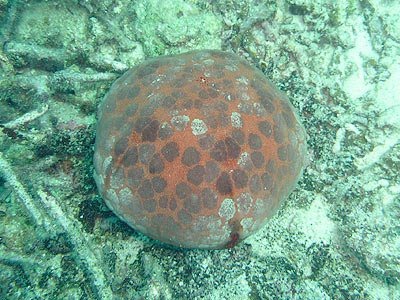
...sometimes they ALSO live in the huge body cavity of the giant cushion stars (Culctia novaeguineae) or even crown of thorns! (Acanthaster planci)
Which as we've seen in prior posts...have just a PALATIAL coelom filled with water and guts-easily accessible via the tube foot groove!!
Parasitic pearlfish species inside starfish will devour tube feet, stomach tissue, gonads, digestive organs, and etc... in the same way they would on sea cucumbers...

But WHAT do any of these fish GET OUT OF THE HOST ANYWAY??? Some thoughts by Parmentier & Vandewalle (2005) include...

Reproduction
  • The commensal Carapus doesn't get food from the host-so what benefit comes?? It turns out that that Carapus spp. may use their host not only as habitat but MAY also as a place to REPRODUCE!! (remember that when two are present you have males and females present!)
  • Its suggested that males and females do teh Sex INSIDE the sea cucumber. The eggs are released via the water currents through the respiratory tree and anus into the water. The juveniles are carried by currents to the open ocean before hatching.
Protection
It turns out that some pearlfish, such as Carapus actually have increased resistance to the sticky toxins produced by Culverian tubules, which many tropical sea cucumber species spurt out and use to defend themselves...like this one...


but the Culverian tubules only seem to react when threats to the external surface of the holothurian are at play!

The intrusion of pearlfish into the cloaca of the sea cucumber? DOES NOT SET OFF the defensive response!!
Is it possible that the sea cucumber hosts are chosen because of their built in defense systems against predators??? What fish wouldn't want to live in a giant sticky-guts shooting house??


One final word, if these fish do so well, then why aren't all species of holothurians (aka sea cucumbers) occupied by pearlfish??

To put it simply, there may simply NOT be the space that permits oxygen respiration for all species...Some pearlfish species are thought to be KEPT out of occupying some large sea cucumber species.

How might that be accomplished?

Two Words: ANAL TEETH.

These structures protect the anus and the cloacal space!

AND as a personal bit of good advice? Don't look up the term "Anal Teeth" on Google Image without the safeties on! It can be....traumatic...